Blog · · 7 min
Claude Code ecommerce skills, what actually exists
One skill is actually about commerce: Medusa's ecommerce-storefront, installed with /plugin marketplace add medusajs/medusa-agent-skills. The rest of the first page is general design skills that never mention a cart. Each install command, and the three gaps none of them fill.
By uxgen
Of the tools an agent finds under this query, exactly one is written for commerce. That is Medusa's ecommerce-storefront skill, installed with /plugin marketplace add medusajs/medusa-agent-skills. The rest (impeccable, Anthropic's frontend-design, UI/UX Pro Max, 21st.dev Magic, the shadcn MCP) are design or component tools that improve how a page looks and say nothing about how it sells. If your merchant's problem is a cart, install Medusa's skill first and treat the others as a second layer.
Everything below was read from the public repositories and registries on 24 August 2026. Install commands are quoted from their own documentation, not reconstructed from memory.
The commerce-aware one
Medusa agent skills. /plugin marketplace add medusajs/medusa-agent-skills adds a marketplace that ships four skills: medusa-dev (backend, admin UI, storefront), learn-medusa (a tutorial), medusa-cloud (cloud resources), and ecommerce-storefront, described by its own README as "a comprehensive skill for building high-converting ecommerce storefronts with best practices."
It is the only entry in this whole category whose stated subject is conversion in a store rather than taste in a layout. Two caveats. It is authored by a backend vendor, so its centre of gravity is a Medusa storefront. And a skill is instructions, not components. It changes what your agent writes. It does not hand it a tested widget.
The taste layer
impeccable. npx impeccable install. Published by Paul Bakaus, Apache-2.0, version 3.6.0 at the time of writing. Its README describes 59 deterministic detector rules plus LLM-only critique checks, and 23 commands reachable as /impeccable <command>, among them init, critique, audit, polish, bolder, quieter, typeset, colorize, animate. impeccable init writes a PRODUCT.md and offers a DESIGN.md so later commands know the audience and the brand lane.
Deterministic detectors are the interesting part: overused fonts, problematic colour pairs, bounce easing. Those are the failures a model repeats because its training corpus repeats them, and a rule catches them more reliably than a critique prompt does. None of the 59 concerns a price, a cart or a shipping threshold.
Anthropic's frontend-design skill ships with Claude Code itself. It is the baseline everything else is measured against, and it is also general-purpose.
UI/UX Pro Max appears in the Claude Code marketplaces and carries real search demand. ui ux pro max measures 3,600 searches a month in Google Ads data, competition index 6, pulled 24 August 2026. Same shape, a design reviewer rather than a commerce one.
The component layer
21st.dev Magic MCP. npx @21st-dev/cli@latest install claude --api-key <key>, with the key from the 21st.dev Magic console. It generates and installs React components from the 21st.dev registry.
shadcn MCP. pnpm dlx shadcn@latest mcp init --client claude. This one is worth more attention than its size suggests. The shadcn MCP browses any shadcn-compatible registry declared in your components.json, not only the default one. That makes it the only supported path for pointing an agent at a commerce-specific block library. See what those registries actually contain.
Shopify Dev MCP. npx -y @shopify/dev-mcp@latest. Documentation and schema access for Shopify APIs. Useful, and firmly on the data side of the line.
The Vercel Labs skills CLI, npx skills add <repo>, is a distributor, not a skill. It installs skills from a repository into Claude, Cursor, Cline, Windsurf and others. Worth knowing because half the install instructions you will read route through it.
The coverage matrix, honestly
Take the parts of a store that actually move revenue and check them one by one against the list above.
- Product page layout and gallery are covered by the component libraries, generically.
- Variant selection is covered too, generically.
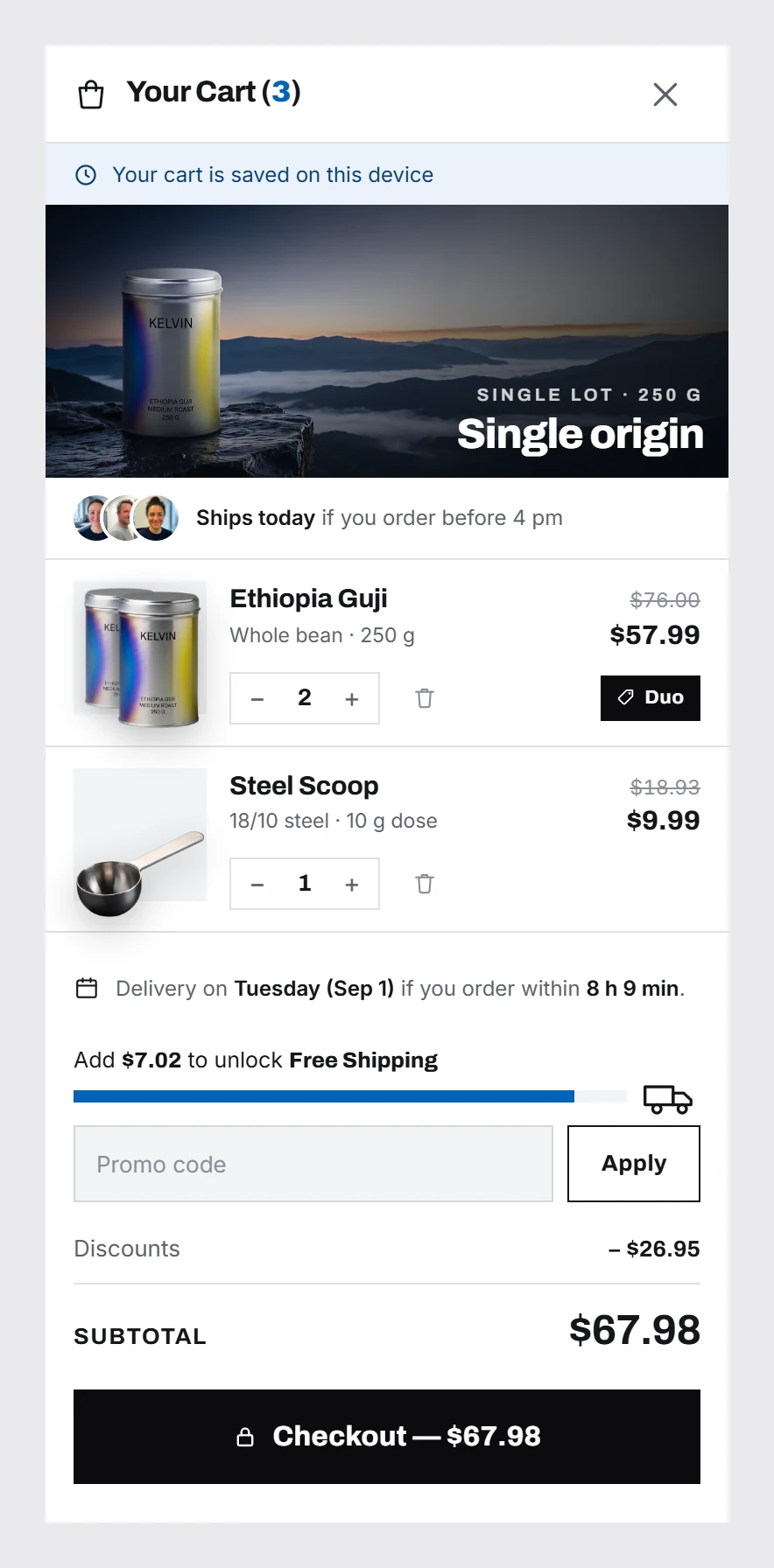
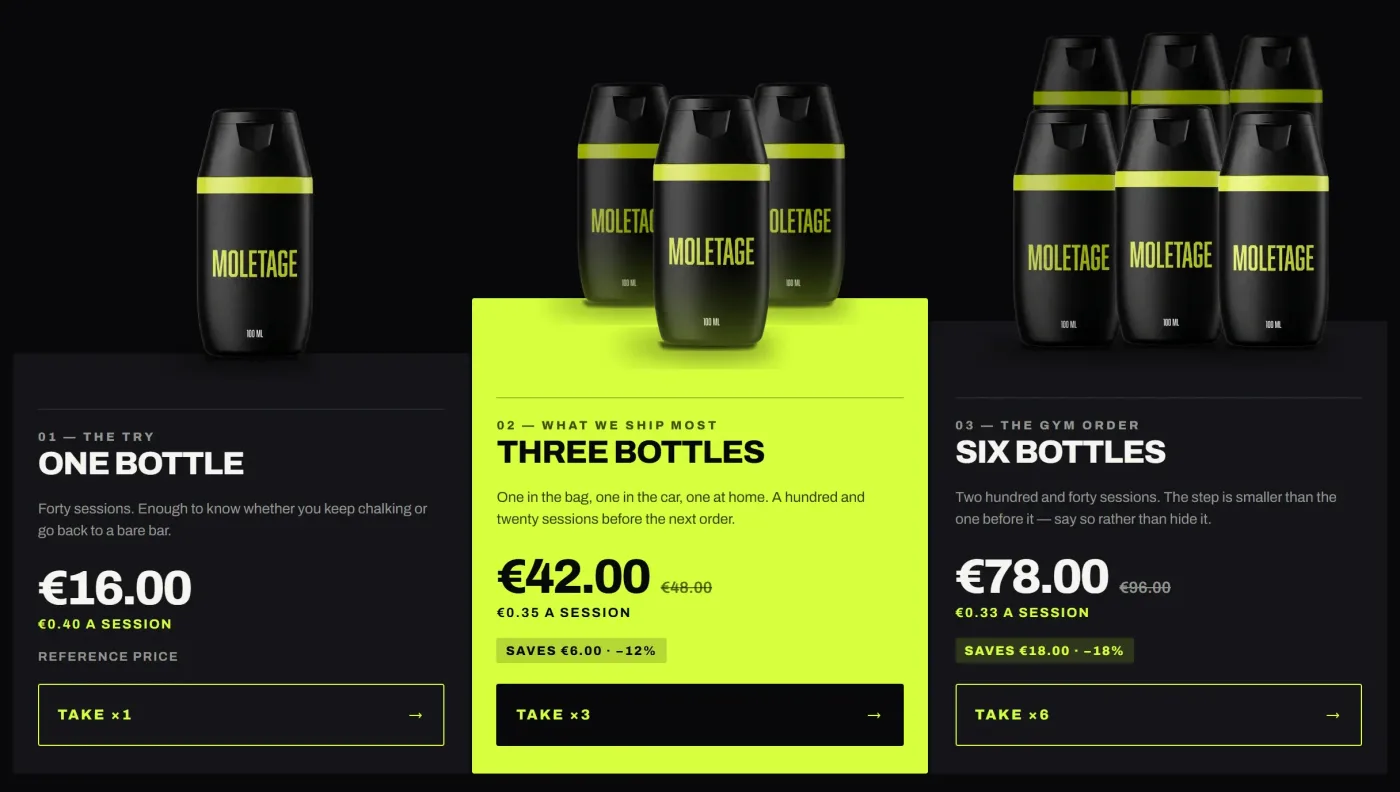
- Quantity tiers and bundles (buy 2, save 15%) are covered by nothing here. Not in shadcn, not in 21st.dev, not in Tailwind Plus. This is the single most common DTC pattern on the web and it has no component. The spec is written out here.
- Free-shipping progress bar, nothing here.
- Upsell and order bump placement, nothing here, and the placement rules carry a legal constraint that several commercial apps ship in violation of by default.
- Sticky mobile add-to-cart, nothing here, on the viewport where most of the traffic is.
- Proof and reviews have components. The content problem is not a component problem, and inventing reviews is an offence, not a design choice.
The three gaps, named
Read across every result on this query and the same three holes appear.
No skill teaches placement. They teach appearance. An agent can be told a button is the wrong shade of indigo and still put the upsell in the one position that costs the merchant the order.
Nothing combines selling mechanics with visual restraint. Every tool is one or the other. Either commercial widgets with no taste, or taste with no commerce. The two halves have never been in the same artefact.
Nobody ships the components a cart is actually made of. Confirmed by reading the category indexes of Tailwind Plus, CommerCN and shadcnblocks on 24 August 2026, and by the official MCP registry returning zero servers for ui components and component library on the same day.
What to install today
If the merchant runs Medusa or a headless Next.js storefront, /plugin marketplace add medusajs/medusa-agent-skills then enable ecommerce-storefront. Add npx impeccable install as a reviewer. Run /impeccable audit on the finished page, not before it. Add the shadcn MCP if you want the agent to pull blocks rather than write them from nothing.
Then write the commerce mechanics by hand. Nothing installs them, as far as we can tell. Related reading: why generated storefronts look alike and how design taste is actually transferred to an agent.
Disclosure. We are building uxgen, an MCP in this category (what it is meant to hand an agent is shown here). Nothing described above is ours, and our own tools are not installable yet.
FAQ
Is there a Claude Code skill for ecommerce?
One in the category is genuinely about commerce, Medusa's ecommerce-storefront, installed with /plugin marketplace add medusajs/medusa-agent-skills. The rest of the first page of results are general design skills that never mention a cart.
Will a design skill make my store convert?
It will make the store look designed. Conversion comes from mechanics those skills do not carry: quantity tiers, a free-shipping threshold, one well-placed complement, sticky add-to-cart on mobile. Looking designed and selling are different problems with different fixes.
How do I install a Claude Code skill?
Most install in one line, either through the plugin marketplace or through the skill's own CLI. Read the repository URL before running it. The recommendation engines do not check popularity, and namesake repositories exist.
What is missing from every skill in this category?
The vocabulary of selling. Search their files for quantity tier, order bump, free-shipping threshold or sticky add-to-cart and you find nothing, in any of them.